Judges at a science fair see the same baking soda volcano again and again. A project that looks different gets noticed first, and it earns better marks.
This list gives you 107 science project ideas for Class 8, sorted by topic. The 10 strongest and most unusual picks come first. Every idea has the items you need, simple steps and the lesson it teaches. Most use things you already have at home.
Read more: 50+ Best Out of Waste Ideas for School Project: Easy and Unique Picks
10 Best Science Project Ideas for Class 8 to Start With

These ten were picked because they are rare in class, easy to explain and fun to show. Adults should handle all cutting and any heat.
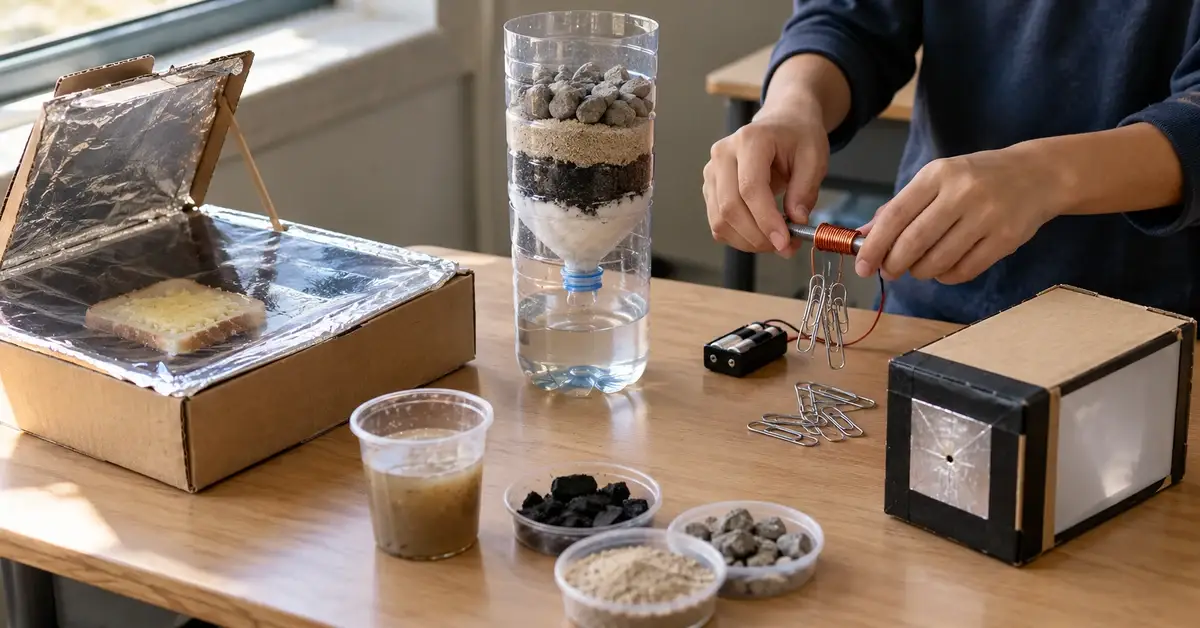
1. Pizza Box Solar Cooker
You need:
- A clean pizza box
- Foil
- Clear plastic wrap
- Black paper
- Tape and a stick
- A thermometer
Steps:
- Cut a flap in the lid and line the inside of the flap with foil.
- Cover the opening with plastic wrap and place black paper in the base.
- Prop the flap with the stick so it reflects sunlight into the box.
- Record the temperature every 10 minutes and try melting cheese on bread.
The lesson: Sunlight turns into heat.
2. Electromagnet Crane
You need:
- A large iron nail
- Insulated copper wire
- One or two 1.5 V cells
- Paper clips
- Tape
Steps:
- Wind 20 turns of wire around the nail and tape the ends to the cell.
- Lift as many paper clips as you can and count them.
- Repeat with 40 turns and compare the results.
The lesson: Electric current creates magnetism, and more coils make it stronger.
3. Three-Layer Water Filter
You need:
- A cut plastic bottle
- Cotton
- Gravel, sand and crushed charcoal
- Muddy water
- A cup
Steps:
- Turn the bottle upside down and place cotton in the neck.
- Add layers of charcoal, sand and gravel on top.
- Pour muddy water through slowly and collect the result.
- Compare the clear water with the original sample.
The lesson: Layers trap dirt of different sizes. Filtered water still needs boiling before drinking.
4. Pinhole Camera
You need:
- A small box
- Tracing paper
- Foil
- A pin
- Black tape
Steps:
- Cut a square hole at one end and cover it with foil.
- Poke a tiny hole in the foil with the pin.
- Cover the opposite end with tracing paper.
- Point the pinhole at a bright window and look at the paper.
The lesson: Light travels in straight lines, so the image forms upside down.
5. Cartesian Diver
You need:
- A clear bottle with a cap
- A glass dropper or pen cap
- Water
- A little clay
Steps:
- Fill the bottle to the top with water.
- Fill the dropper halfway so it just floats and add clay if needed.
- Drop it into the bottle and close the cap tightly.
- Squeeze the bottle to sink the diver and release to raise it.
The lesson: Pressure changes how much a diver floats.
6. Hydraulic Lift
You need:
- Two syringes of different sizes
- A plastic tube
- Water
- A cardboard platform
- Small weights
Steps:
- Fill both syringes and the tube with water and join them.
- Fix the platform on the larger syringe.
- Press the smaller syringe and watch the platform rise.
- Add weights and see how many it lifts.
The lesson: Liquids pass pressure equally in all directions.
7. Red Cabbage Indicator
You need:
- Red cabbage
- Hot water
- Clear glasses
- Lemon juice, vinegar, soap and baking soda
Steps:
- Soak chopped cabbage in hot water until the liquid turns purple.
- Pour equal amounts into five glasses.
- Add a different household item to each glass.
- Note the colours and make a chart from red to green.
The lesson: Some plant pigments change colour with acids and bases.
8. Tornado in a Bottle
You need:
- Two plastic bottles
- Strong tape
- Water
- Glitter
- Dish soap
Steps:
- Fill one bottle two-thirds with water and add glitter and a drop of soap.
- Tape the second bottle upside down on top, neck to neck.
- Flip the set and swirl it in a circle.
- Time how long the water takes to drain with and without swirling.
The lesson: Spinning water forms a vortex, like winds in a storm.
9. Plant Maze
You need:
- A shoebox
- Cardboard strips
- A small bean sprout
- Tape
- A sunny window
Steps:
- Cut a hole at one end of the box.
- Tape cardboard strips inside to form a maze.
- Place the plant at the far end and close the lid.
- Open the box every few days and photograph the growth.
The lesson: Plants grow toward light.
10. Earthquake-Proof Tower
You need:
- Toothpicks
- Marshmallows or clay
- A flat tray
- A ruler
Steps:
- Build a tall tower with a plain square base.
- Build a second tower with cross braces and a wide base.
- Place each on the tray and shake it side to side.
- Record how long each stands.
The lesson: Wide bases and braces help buildings resist shaking.
Read more: 149+ Science Fair Project Ideas for 6th Graders (Easy & Fun)
How to Pick the Right Science Project for Class 8

Start with a question, not a model. “Which surface has the most friction?” is a better start than “I will build something.”
- Check what you already have at home before you shop.
- Count your days. Plant projects need one to two weeks, and most physics tests finish in an hour.
- Ask your teacher whether the project must link to a chapter you are studying.
- Keep a notebook. Write your guess, steps, results and one surprise.
- Never use mains electricity. Use small cells and batteries only.
Science Project Ideas for Class 8 on Force, Friction and Pressure
Test one thing at a time in each project. Change only one factor and keep everything else the same.
11. Friction on Different Surfaces
You need:
- A wooden block
- A ramp
- Tile, cloth, sandpaper and glass
- A ruler
Steps:
- Cover the ramp with each surface in turn.
- Slide the block from the same height each time.
- Measure how far it travels.
The lesson: Rough surfaces create more friction.
12. Shoe Grip Test
You need:
- Four different shoes
- A spring balance
- A smooth floor
Steps:
- Hook the balance to a shoe and pull it steadily.
- Note the force when it starts to move.
- Repeat for every shoe and rank them.
The lesson: Sole patterns change grip.
13. Rolling Versus Sliding
You need:
- A heavy book
- Six pencils
- A spring balance
- A table
Steps:
- Drag the book along the table and record the force.
- Place pencils underneath and pull again.
- Compare the two readings.
The lesson: Rolling needs far less force than sliding.
14. Lubricant Test
You need:
- Two wooden boards
- Oil, soap and water
- A weight
- A spring balance
Steps:
- Place a weight on one board and pull it across the other.
- Add a different lubricant each time.
- Record the force needed.
The lesson: Liquids reduce friction between surfaces.
15. Water Pressure Bottle
You need:
- A tall plastic bottle
- A nail
- Water
- A tray
Steps:
- Ask an adult to poke three holes at different heights.
- Cover the holes, fill the bottle and set it on the tray edge.
- Uncover the holes and mark where each jet lands.
The lesson: Pressure rises with depth.
16. Paper Bridge Strength
You need:
- Sheets of paper
- Two stacks of books
- Coins
- Tape
Steps:
- Lay a flat sheet between the stacks and add coins until it sags.
- Fold another sheet into pleats and repeat.
- Compare how many coins each holds.
The lesson: Folds add strength to thin material.
17. Parachute Drag
You need:
- Plastic bags
- String
- Small weights
- A stopwatch
Steps:
- Make parachutes in small, medium and large sizes.
- Drop each from the same height.
- Time the fall three times and average it.
The lesson: Air resistance slows a falling object.
18. Balloon Rocket
You need:
- A long string
- A straw
- A balloon
- Tape
Steps:
- Thread the string through the straw and tie it across a room.
- Tape the inflated balloon to the straw.
- Release it and measure the distance travelled.
The lesson: Every action has an equal and opposite reaction.
Light and Sound Science Project Ideas for Class 8
19. Periscope
You need:
- A milk carton
- Two small mirrors
- Tape
- Scissors
Steps:
- Cut a window at the top on one side and another at the bottom on the opposite side.
- Tape a mirror inside each window at 45 degrees, facing each other.
- Look through the bottom window to see over a wall.
The lesson: Mirrors turn light at an angle.
20. Homemade Rainbow
You need:
- A glass of water
- A torch
- White paper
- A dark room
Steps:
- Place the glass near the edge of a table with paper below it.
- Shine the torch through the water at an angle.
- Adjust the angle until colours appear.
The lesson: Water bends light and splits it into colours.
21. Colour Wheel
You need:
- A card circle
- Paints or crayons
- A pencil
- A thread
Steps:
- Divide the circle into seven parts and colour each.
- Push a pencil through the centre.
- Spin it fast and watch the colours blur.
The lesson: Mixed colours of light appear white.
22. Shadow Length Through the Day
You need:
- A stick
- Chalk
- A measuring tape
- Sunny ground
Steps:
- Fix the stick upright in the ground.
- Mark the shadow tip and measure it every hour.
- Plot the lengths on a graph.
The lesson: Shadows change as the Sun moves.
23. Law of Reflection
You need:
- A small mirror
- A torch
- A protractor
- A black card with a slit
Steps:
- Shine a thin beam on the mirror at 30, 45 and 60 degrees.
- Measure the angle of the reflected beam.
- Compare the two angles in each case.
The lesson: The angle of incidence equals the angle of reflection.
24. Bent Pencil
You need:
- A clear glass
- Water
- A pencil
- A ruler
Steps:
- Place the pencil in the glass and look from the side.
- Measure how far the image seems to shift.
- Try with oil in place of water.
The lesson: Light bends when it enters a new material.
25. String Telephone
You need:
- Two paper cups
- A long string
- A paper clip
Steps:
- Poke a hole in each cup and tie the string.
- Pull it tight and talk into one cup.
- Try loose string, then wet string, and compare.
The lesson: Sound travels through solids as vibrations.
26. Dancing Rice
You need:
- A bowl
- Cling film
- Rice grains
- A pan and spoon
Steps:
- Stretch cling film over the bowl and sprinkle rice on top.
- Bang the pan close to the bowl.
- Watch the rice jump.
The lesson: Sound makes air vibrate.
27. Glass Xylophone
You need:
- Six glasses
- Water
- A spoon
- Food colour
Steps:
- Fill each glass to a different level and add colour.
- Tap each one gently.
- Arrange them to play a simple song.
The lesson: Less water gives a higher sound.
28. Soundproof Box
You need:
- A shoebox
- A phone alarm
- Cotton, foam, cloth and newspaper
Steps:
- Place the alarm in the box and line it with one material.
- Close the lid and listen from two metres away.
- Repeat for each material and rank them.
The lesson: Soft materials absorb sound.
Electricity and Magnetism Project Ideas

Use only small cells and batteries for every project in this section.
29. Simple Motor
You need:
- A battery
- A strong magnet
- Copper wire
- Two paper clips
Steps:
- Coil the wire into a loop with two straight ends.
- Rest the ends on the paper clips attached to the battery.
- Place the magnet underneath and give the loop a gentle push.
The lesson: Electric current in a magnetic field makes things move.
30. Conductor and Insulator Tester
You need:
- A cell
- A small bulb and holder
- Wires
- Coins, keys, rubber, plastic and wood
Steps:
- Build a circuit with a gap in it.
- Place each item across the gap.
- Record which ones light the bulb.
The lesson: Metals conduct electricity, while most other materials do not.
31. Lemon Battery
You need:
- Three lemons
- Copper coins
- Zinc nails
- Wires
- A small LED
Steps:
- Push a coin and a nail into each lemon.
- Connect the lemons in a chain with wires.
- Link the ends to the LED.
The lesson: Acid and two metals can make an electric cell.
32. Potato Battery
You need:
- Two potatoes
- Copper and zinc strips
- Wires
- An LED
Steps:
- Insert a strip of each metal into each potato.
- Connect them in a chain.
- Compare brightness with the lemon battery.
The lesson: Different fruits and vegetables give different power.
33. House Circuit Model
You need:
- A cardboard house
- Bulbs
- Switches
- A battery
- Wires
Steps:
- Put a bulb and switch in each room.
- Connect all rooms in parallel to one battery.
- Turn each bulb on and off alone.
The lesson: Parallel wiring lets each light work separately.
34. Burglar Alarm
You need:
- A buzzer
- A battery
- Foil strips
- A card door
Steps:
- Stick foil strips on the door and its frame.
- Connect them in a circuit with the buzzer.
- Open the door to break the contact and sound the alarm.
The lesson: A switch can sense movement.
35. Iron Filings Field Map
You need:
- A bar magnet
- Iron filings
- White paper
Steps:
- Place the paper over the magnet.
- Sprinkle the filings and tap gently.
- Photograph the pattern.
The lesson: Magnets have an invisible field around them.
36. Floating Compass
You need:
- A sewing needle
- A bar magnet
- A leaf or cork
- A bowl of water
Steps:
- Rub the needle along the magnet in one direction 30 times.
- Place the needle on the leaf and float it in the bowl.
- Check which way it points.
The lesson: A magnet lines up with Earth’s magnetic field.
37. Static Electricity Test
You need:
- A plastic comb
- Dry hair
- Tiny paper pieces
Steps:
- Rub the comb on dry hair for 20 seconds.
- Hold it above the paper bits and count what it lifts.
- Repeat on a humid day.
The lesson: Rubbing makes charge, and damp air removes it.
38. Conductivity of Liquids
You need:
- Tap water, salt water, sugar water and lemon juice
- A bulb circuit
- Two carbon rods or pencil leads
Steps:
- Place the rods in each liquid in turn.
- Watch the bulb brightness.
- Rank the liquids.
The lesson: Some liquids carry current and others do not.
Heat and Energy Project Ideas
39. Conduction With Wax Beads
You need:
- Strips of copper, iron and aluminium
- Wax
- A candle
- Tongs
Steps:
- Stick small wax beads along each strip.
- Ask an adult to heat one end of each strip.
- Note which strip drops its beads first.
The lesson: Metals carry heat at different speeds.
40. Convection Currents
You need:
- A clear tall glass
- Cold water
- Hot water in a small bottle
- Food colour
Steps:
- Fill the glass with cold water.
- Tint the hot water and place the bottle inside.
- Watch the colour rise and spread.
The lesson: Warm liquid rises and cool liquid sinks.
41. Dark Versus Light Cans
You need:
- Two cans, one black and one white
- Water
- Two thermometers
Steps:
- Fill both cans with the same water.
- Leave them in the sun for an hour.
- Compare the temperatures.
The lesson: Dark colours absorb more heat.
42. Best Insulator
You need:
- Four identical bottles
- Wool, foil, paper and cloth
- Hot water
- A thermometer
Steps:
- Wrap each bottle in a different material.
- Fill them with hot water and note the starting temperature.
- Check again every 15 minutes.
The lesson: Trapped air slows heat loss.
43. Ice Melting Under Colours
You need:
- Ice cubes
- Black, white, red and yellow paper
- A sunny spot
Steps:
- Place a cube on each paper.
- Start a timer.
- Note when each cube melts.
The lesson: Colour affects how much heat a surface takes in.
44. Sea Breeze Model
You need:
- Two trays
- Sand and water
- A lamp
- Two thermometers
Steps:
- Fill one tray with sand and the other with water.
- Place the lamp above both for 20 minutes.
- Record the temperature of each.
The lesson: Land heats faster than water, which drives sea breezes.
45. Pendulum Length
You need:
- A string
- A small weight
- A stopwatch
- A stand
Steps:
- Hang the weight at 20 cm, 40 cm and 60 cm.
- Time ten swings each.
- Plot time against length.
The lesson: Longer pendulums swing slower.
Read more: 20 Fun and Easy Digestive System Project Ideas for Students
Chemistry Project Ideas for Class 8

46. Turmeric Paper Test
You need:
- Turmeric powder
- Spirit or water
- Filter paper
- Soap solution
Steps:
- Mix turmeric with spirit and soak the paper in it.
- Dry the paper and cut it into strips.
- Dip a strip in soap solution and watch it turn red.
The lesson: Soap is a base.
47. Household Acids and Bases
You need:
- Ten kitchen items
- Red cabbage juice
- Small cups
Steps:
- Add a few drops of juice to each item.
- Record each colour.
- Sort the items into acids, bases and neutral.
The lesson: Everyday items are acidic or basic.
48. Antacid Comparison
You need:
- Three antacid tablets
- Diluted vinegar
- Indicator juice
- Cups
Steps:
- Crush each tablet and add it to its own cup of vinegar.
- Add indicator and stir.
- Note which tablet changes the colour first.
The lesson: Bases neutralise acids.
49. Invisible Ink
You need:
- Lemon juice
- A cotton bud
- White paper
- A warm lamp
Steps:
- Write a message with the juice and let it dry.
- Hold the paper near a warm lamp with adult help.
- Watch the message turn brown.
The lesson: Heat darkens the acid in lemon juice.
50. Rusting Conditions
You need:
- Four iron nails
- Four jars
- Water, salt water and oil
Steps:
- Place a nail in dry air, plain water, salt water and oil.
- Check them daily for a week.
- Photograph each result.
The lesson: Iron rusts with air and moisture.
51. Preventing Rust
You need:
- Four nails
- Paint, grease and wax
- A damp tray
Steps:
- Coat three nails in different layers and leave one bare.
- Place them in a damp tray.
- Compare after one week.
The lesson: Coatings keep air and water away.
52. Crystal Growing
You need:
- Alum or salt
- Hot water
- A jar
- A thread and a pencil
Steps:
- Dissolve as much alum as you can in hot water.
- Tie the thread to a pencil and hang it in the jar.
- Wait three days and watch crystals form.
The lesson: Crystals grow as water evaporates.
53. Hard Versus Soft Water
You need:
- Tap, boiled and distilled water
- Soap flakes
- Three bottles
Steps:
- Add equal soap to each bottle and shake.
- Measure the foam height.
- Rank the water samples.
The lesson: Hard water makes less lather.
54. Chromatography
You need:
- Filter paper
- Markers
- A glass of water
Steps:
- Draw a dot near the bottom of the paper.
- Dip the bottom edge in water without touching the dot.
- Watch the ink split into colours.
The lesson: Mixtures can be separated by how they travel.
55. Evaporation Rates
You need:
- Three plates
- Water, oil and spirit
- A dropper
Steps:
- Place ten drops of each liquid on its plate.
- Time how long each takes to disappear.
- Note which dries first.
The lesson: Liquids evaporate at different speeds.
56. Temperature and Dissolving
You need:
- Three glasses
- Cold, warm and hot water
- Sugar
- A spoon
Steps:
- Add one spoon of sugar to each glass.
- Stir the same number of times.
- Time how long it takes to dissolve.
The lesson: Heat helps solids dissolve faster.
57. Carbon Dioxide Extinguisher
You need:
- A bottle
- Baking soda
- Vinegar
- A short candle
- A tube
Steps:
- Place baking soda and vinegar in the bottle.
- Direct the gas through the tube toward a lit candle with adult help.
- Watch the flame go out.
The lesson: Carbon dioxide stops burning.
58. Candle Under a Jar
You need:
- Three jars of different sizes
- Three candles
- A stopwatch
Steps:
- Light each candle with adult help.
- Cover each with a different jar at the same time.
- Record how long each burns.
The lesson: Burning needs oxygen.
59. Starch Bioplastic
You need:
- Cornflour
- Glycerine
- Vinegar
- Water
- A pan
Steps:
- Ask an adult to heat all the items gently until thick.
- Spread the mix thin on foil.
- Let it dry for two days.
The lesson: Plants can make plastic-like film.
60. Biodegradable Burial
You need:
- Plastic, paper, peels and cloth
- Soil
- A tray
Steps:
- Bury each item in the same soil.
- Dig up after three weeks.
- Compare what has broken down.
The lesson: Some waste breaks down and some does not.
61. Volcano With a Twist
You need:
- Baking soda
- Vinegar, lemon juice and cola
- A clay cone
- A tray
Steps:
- Build a clay cone around a small cup.
- Add the same amount of baking soda and a different acid each time.
- Measure the foam height.
The lesson: Stronger acids react faster.
Plant Science Project Ideas for Class 8

62. Light Versus Dark Growth
You need:
- Two identical seedlings
- A dark box
- A ruler
Steps:
- Place one seedling in sunlight and one in the dark box.
- Water both the same.
- Measure height and leaf colour weekly.
The lesson: Plants need light to stay healthy.
63. Roots and Gravity
You need:
- Bean seeds
- Damp cotton
- A clear jar
Steps:
- Sprout beans in the jar against the glass.
- Turn the jar on its side after three days.
- Note the new direction of roots.
The lesson: Roots grow toward gravity.
64. Type of Water
You need:
- Four identical plants
- Tap, salt, soapy and rain water
Steps:
- Water each plant with a different type.
- Record growth for two weeks.
- Photograph every few days.
The lesson: Water quality changes plant health.
65. Transpiration Bag
You need:
- A leafy branch on a plant
- A clear bag
- String
Steps:
- Tie the bag around the leaves.
- Leave it in sun for a day.
- Measure the water collected.
The lesson: Leaves release water vapour.
66. Stomata Under a Microscope
You need:
- A fresh leaf
- Clear nail polish
- Tape
- A microscope
Steps:
- Paint a small patch of polish on the leaf underside.
- Peel it off with tape once dry.
- View it and count the pores in one frame.
The lesson: Leaves breathe through tiny openings.
67. Leaf Pigments
You need:
- Green leaves
- Spirit
- Filter paper
- A jar
Steps:
- Crush the leaves in spirit.
- Dip a filter paper strip in the liquid.
- Spot the green and yellow bands.
The lesson: Leaves hold more than one pigment.
68. Starch in Leaves
You need:
- Two leaves, one from sun and one from shade
- Iodine
- Hot water
- Spirit
Steps:
- Boil each leaf in water with adult help and soak in spirit.
- Rinse and add iodine drops.
- Compare the colours.
The lesson: Sunlit leaves make starch.
69. Seed Germination Conditions
You need:
- Bean seeds
- Four dishes
- Cotton and water
Steps:
- Keep seeds dry, wet, cold and warm in separate dishes.
- Check daily.
- Record which sprout first.
The lesson: Seeds need water and warmth.
70. Soil Types
You need:
- Sand, clay and garden soil
- Three pots
- Seeds
Steps:
- Plant the same seeds in each pot.
- Water equally.
- Measure growth after ten days.
The lesson: Soil type affects growth.
71. Celery Capillary Action
You need:
- A celery stalk
- Water
- Food colour
- A knife
Steps:
- Place the stalk in coloured water overnight.
- Ask an adult to slice it open.
- Look for the dye in the tubes.
The lesson: Plants pull water up narrow tubes.
72. Water-Only Gardening
You need:
- Two bean plants
- Jars
- Water
- Plant food
Steps:
- Grow one in plain water and one with plant food.
- Change the water weekly.
- Compare root length.
The lesson: Plants can grow without soil if given nutrients.
Microorganism, Health and Body Project Ideas
73. Bread Mould
You need:
- Four bread slices
- Zip bags
- Water
Steps:
- Keep slices in warm, cold, dry and damp spots.
- Check daily without opening bags.
- Record when mould appears.
The lesson: Mould grows best in warm, damp places.
74. Yeast and Gas
You need:
- Dry yeast
- Sugar
- Warm water
- A bottle and a balloon
Steps:
- Mix yeast and sugar in warm water in the bottle.
- Stretch the balloon over the neck.
- Watch it inflate.
The lesson: Yeast makes gas as it feeds.
75. Curd and Temperature
You need:
- Milk
- A spoon of curd
- Three bowls
Steps:
- Warm milk to three different temperatures.
- Add curd and cover.
- Check which sets best after eight hours.
The lesson: Helpful bacteria work best in mild warmth.
76. Handwashing Test
You need:
- Potato slices
- Three zip bags
Steps:
- Press unwashed, soap-washed and water-washed fingers on separate slices.
- Seal the bags and keep them in a warm place.
- Compare after a week without opening them.
The lesson: Soap removes germs better than water alone.
77. Pond Water Under a Microscope
You need:
- A pond water sample
- A slide
- A microscope
Steps:
- Place a drop on the slide and view it.
- Draw what you see.
- Name as many as you can.
The lesson: Pond water holds many tiny living things.
78. Food Preservation
You need:
- Four fruit slices
- Salt, sugar and oil
Steps:
- Coat three slices with salt, sugar and oil and leave one plain.
- Place them in open dishes.
- Note which spoil first.
The lesson: Preservatives slow down spoilage.
79. Lung Model
You need:
- A plastic bottle
- Two balloons
- A straw
- Clay
Steps:
- Cut the bottom off the bottle and cover it with a balloon.
- Place a smaller balloon inside on a straw.
- Pull the bottom balloon down and watch the inner one fill.
The lesson: Breathing depends on the diaphragm.
80. Heart Pump Model
You need:
- Two bottles
- Tubes
- Water
- A bulb pump
Steps:
- Join the bottles with tubes.
- Squeeze the pump to move water.
- Add a valve to stop backflow.
The lesson: Valves keep blood moving in one direction.
81. Reaction Time
You need:
- A ruler
- A friend
Steps:
- Your friend drops the ruler without warning.
- Catch it and note the distance.
- Compare results across five tries.
The lesson: The brain takes time to send signals.
82. Blind Spot Test
You need:
- White paper
- A marker
Steps:
- Draw a dot and a cross 8 cm apart.
- Close your left eye and look at the cross.
- Move the paper closer until the dot vanishes.
The lesson: Each eye has a spot with no sight.
83. Vitamin C in Juices
You need:
- Four juices
- Diluted starch
- Iodine
- A dropper
Steps:
- Mix starch and iodine until blue.
- Add each juice drop by drop.
- Count how many drops clear the colour.
The lesson: Juices with more vitamin C clear the blue sooner.
Weather and Environment Project Ideas for Class 8

84. Rain Gauge
You need:
- A straight bottle
- A ruler
- Marker
Steps:
- Cut the top off and mark a scale on the side.
- Place it outside in the open.
- Record daily rain for a month.
The lesson: Rain can be measured with a simple tool.
85. Anemometer
You need:
- Four paper cups
- Two sticks
- A pin
- A pencil
Steps:
- Cross the sticks and fix a cup on each end.
- Pin the centre to a pencil.
- Count spins per minute.
The lesson: Faster spins show stronger wind.
86. Wind Vane
You need:
- A straw
- Card
- A pin
- A pencil
Steps:
- Attach an arrow head and tail on the straw.
- Pin it to a pencil end.
- Note the direction it points.
The lesson: Wind direction can be read from a vane.
87. Barometer in a Jar
You need:
- A jar
- A balloon
- A straw
- A rubber band
Steps:
- Stretch the balloon across the jar and seal it.
- Tape the straw on top as a pointer.
- Mark the pointer position each day.
The lesson: Air pressure changes with weather.
88. Hygrometer
You need:
- Two thermometers
- A wet cloth
Steps:
- Wrap one bulb in the wet cloth.
- Read both after ten minutes.
- Find the gap between them.
The lesson: A bigger gap shows drier air.
89. Water Cycle in a Bag
You need:
- A zip bag
- Water
- Tape
Steps:
- Pour a little water in the bag and seal it.
- Tape it to a sunny window.
- Watch drops form and fall.
The lesson: Water evaporates, condenses and falls again.
90. Acid Rain Effect
You need:
- Two plants
- Diluted vinegar
- Plain water
Steps:
- Water one plant with plain water and the other with diluted vinegar.
- Repeat daily for a week.
- Compare the leaves.
The lesson: Acidic water damages plants.
91. Air Pollution Cards
You need:
- White cards
- Petroleum jelly
- String
Steps:
- Coat each card with a thin layer.
- Hang them near a road, a garden and a classroom.
- Compare the dust after a week.
The lesson: Dust levels differ by place.
92. Soil Erosion
You need:
- Two trays
- Soil
- Grass
- A watering can
Steps:
- Fill both trays with soil and plant grass in one.
- Tilt them and pour water.
- Compare the runoff.
The lesson: Roots hold soil in place.
93. Greenhouse Jars
You need:
- Two jars
- Two thermometers
- A lid
Steps:
- Place a thermometer in each jar and cover one.
- Set both in sunlight.
- Record the temperatures every ten minutes.
The lesson: Trapped heat raises temperature.
94. Oil Spill Clean-Up
You need:
- A tray of water
- Cooking oil
- Cotton, a spoon and feathers
Steps:
- Pour oil on the water.
- Try each tool to remove it.
- Rank how well each works.
The lesson: Oil spills are hard to clean.
Earth, Moon and Sun Project Ideas
95. Moon Phases
You need:
- A ball
- A lamp
- A dark room
Steps:
- Hold the ball at arm’s length and turn slowly.
- Watch how the lit part changes.
- Draw each phase.
The lesson: Moon phases come from the angle of sunlight.
96. Eclipse Model
You need:
- Three balls of different sizes
- A torch
- A table
Steps:
- Use the large ball as the Sun’s light source, the medium one as Earth and the small one as the Moon.
- Line them up and watch the shadow fall.
- Repeat to show both eclipse types.
The lesson: Eclipses happen when three bodies line up.
97. Seasons Model
You need:
- A globe
- A torch
- A stand
Steps:
- Tilt the globe and keep the torch fixed.
- Move the globe around the torch.
- Note which part gets more light.
The lesson: Tilt causes the seasons.
98. Sun Shadow Gnomon
You need:
- A stick
- Chalk
- A flat spot
Steps:
- Mark the shadow tip every hour.
- Find the shortest shadow.
- Note the time of local noon.
The lesson: The Sun is highest at midday.
99. Solar System to Scale
You need:
- Beads or balls
- A long path
- A measuring tape
Steps:
- Pick a small scale for each planet.
- Place them along the path at scaled distances.
- Label each one.
The lesson: The gaps in space are huge.
100. Moon Crater Model
You need:
- A tray
- Flour
- Cocoa powder
- Marbles
Steps:
- Fill the tray with flour and dust it with cocoa.
- Drop marbles from different heights.
- Measure the craters.
The lesson: Impact speed shapes craters.
101. Planetarium Box
You need:
- A box
- A torch
- Black paper
- A pin
Steps:
- Poke a star pattern in the paper and fit it over the torch.
- Shine it on a wall in the dark.
- Name the star group.
The lesson: Stars form patterns we can map.
Working Model Ideas for Class 8
102. Closed Bottle Ecosystem
You need:
- A large clear bottle
- Pebbles, soil and moss
- Water
Steps:
- Layer pebbles and soil in the base.
- Plant the moss and add a little water.
- Seal the bottle and place it near a window.
The lesson: Water and air move in a cycle inside a closed space.
103. Windmill
You need:
- Card
- A stick
- A pin
- A small motor
Steps:
- Cut four blades and fix them to the stick.
- Attach the stick to the motor.
- Test with a fan and light an LED.
The lesson: Wind can turn a motor.
104. Water Wheel
You need:
- Plastic spoons
- A cork
- A stick
- A tap
Steps:
- Push spoons into the cork around its edge.
- Mount it on the stick.
- Hold it under a stream of water.
The lesson: Moving water carries energy.
105. Smart Street Light
You need:
- A light sensor
- A bulb
- A battery
- Wires
Steps:
- Connect the sensor in the circuit with the bulb.
- Cover the sensor with a cup.
- Watch the bulb come on.
The lesson: Sensors respond to light. Ask a teacher or an older sibling to help with wiring.
106. Seismograph
You need:
- A frame
- A pen
- A paper strip
- A weight
Steps:
- Hang the weighted pen so its tip touches the paper.
- Pull the paper slowly.
- Shake the table and look at the line.
The lesson: Instruments record ground motion.
107. Rainwater Harvesting Model
You need:
- Card
- Bottles
- A tube
- A tray
Steps:
- Build a card roof with a gutter.
- Connect the gutter to a bottle tank.
- Pour water on the roof and measure the amount collected.
The lesson: Rainwater can be saved for later use.
Read more: 15 Creative Family Tree Project Ideas for School
How to Score Higher in Your Science Project
Ask your teacher what the marking points are before you start. Many schools look at the idea, the method, the neatness and how well you explain it.
- Write a guess before you test anything.
- Run each test at least three times and use the average.
- Show your results in a table or a graph.
- Take photos of each stage.
- Practise a one-minute talk that covers the question, the test and the answer.

Safety Rules to Follow
- Adults should handle all cutting, heat, flames and chemicals.
- Wear gloves and goggles when working with any acid or dye.
- Use only small cells and batteries for circuits. Never touch a wall socket.
- Do not taste or smell any test liquid.
- Wash your hands after every project.
Read more: American Horror Story Season 13 Review: Lange Returns, but Is It Worth Your Time?
FAQ
What is the easiest science project for Class 8?
A water filter, a pinhole camera or a rusting test are easy picks. They need only a few cheap items and give clear results. You can finish any of them in a few days.
How do I make my science project stand out?
Test one clear question and show your results on a graph. Judges like projects that include a guess, a method and a finding. A neat chart often matters more than a big model.
Can I do these projects at home without special tools?
Yes. Most ideas use kitchen items, paper, bottles and small batteries. Only a few need a microscope or a magnifier, which many schools can lend you.
How long should a Class 8 science project report be?
One to two pages is enough. Include your aim, materials, steps, results and one clear conclusion. Add photos or drawings to show each stage.
Which project is best for a school exhibition?
Working models draw the most attention. Try the solar cooker, the electromagnet crane, the windmill or the water filter. Keep a short demo ready that takes under a minute.